

E-commerce looks like AI’s easiest target. With Claude or ChatGPT you can build a professional-looking online store in ten prompts. The platforms that charged for that for years should be bleeding.
Are they? Who adapts and who doesn’t? I looked at data nobody quotes: how much internet traffic each platform actually serves. The answer isn’t what I expected. And it leads to a company almost nobody watches.
What survives an AI agent?
An agent can find a product, compare prices and press “buy”. It can’t take legal responsibility: pay import duty in Japan, remit VAT in Germany, eat the fraud risk, handle a return across a border. So here’s my test for what survives the agents. Six questions:
Does it carry liability AI can’t take (licences, legal risk, money on the balance sheet)?
Does it touch the physical world?
Does it own data agents need?
Does the merchant pay it per transaction, whichever agent wins?
Is its core asset something other than customer attention?
Is it hard to rip out?
Middlemen that sell attention fail most of these. Infrastructure passes. Keep the list in mind: one company below passes almost all six.
First: is the data any good?
How I measured. Cisco's Umbrella service publishes a daily list of the million most-requested internet domains. For each platform I took the domain that serves its stores' images and files (cdn.shopify.com, for example), so the rank follows shopper traffic, not visits to the company's own website. I only compare platforms with each other, as ratios, because Cisco changed its method twice (2021 and 2026). Blind spots: stores on their own domains, and anything too small to rank.
Before trusting it, I tested it where the answer is public. BigCommerce and Shopify both report revenue. In years when BigCommerce grew much slower than Shopify, its DNS traffic slipped against Shopify. When the gap narrowed, it recovered. The rule was written down before I looked.
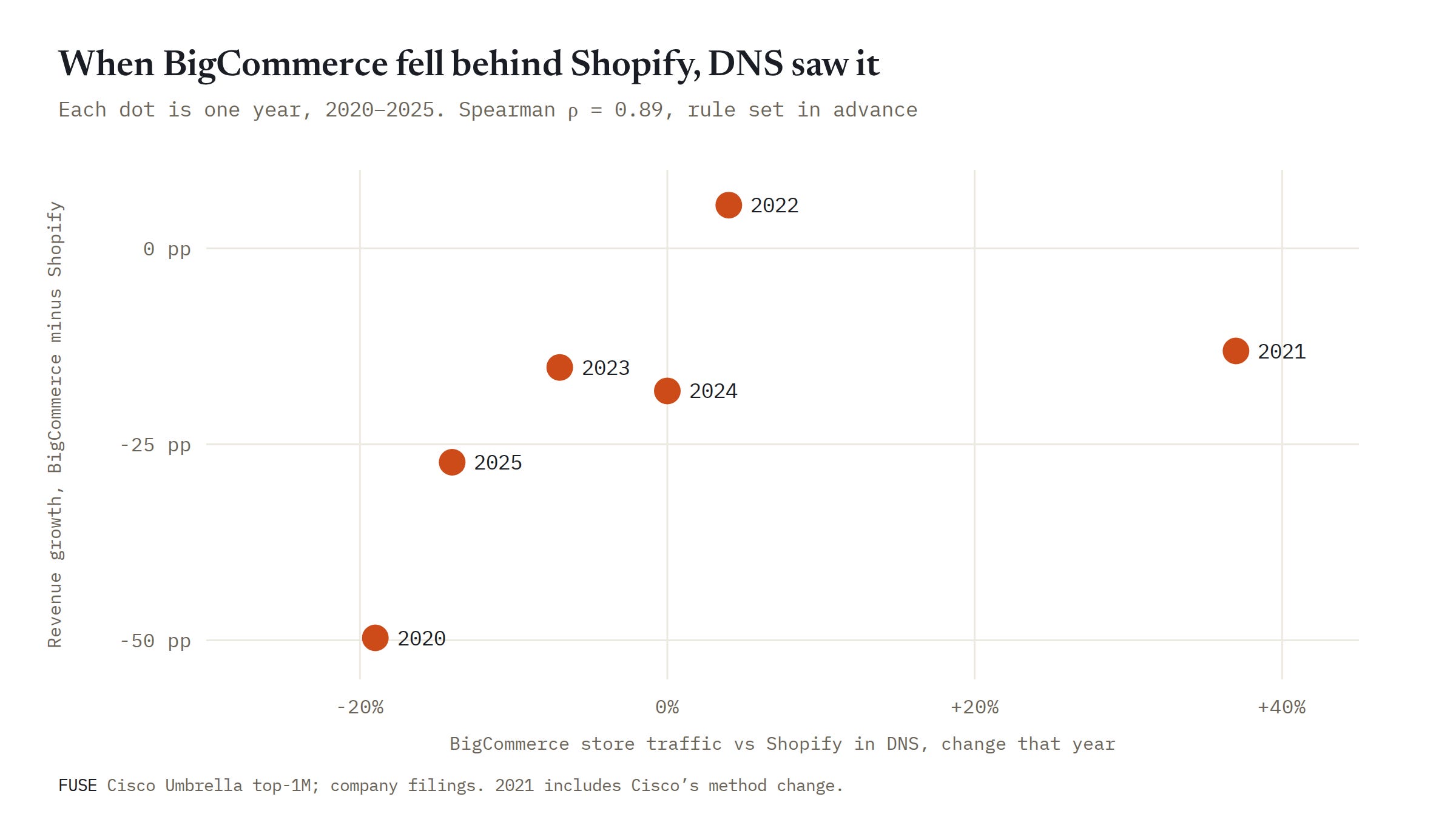
It doesn’t work everywhere. VTEX showed a jump that was just Cisco changing its method. Feedonomics is too small to rank reliably. Shoptet and commercetools lack history. I dropped them.
Shopify is crushing it. Only its partner keeps up.
Then I compared the ten platforms with usable data against Shopify since 2019. AI hasn’t killed anyone yet. But the market is concentrating into one name.
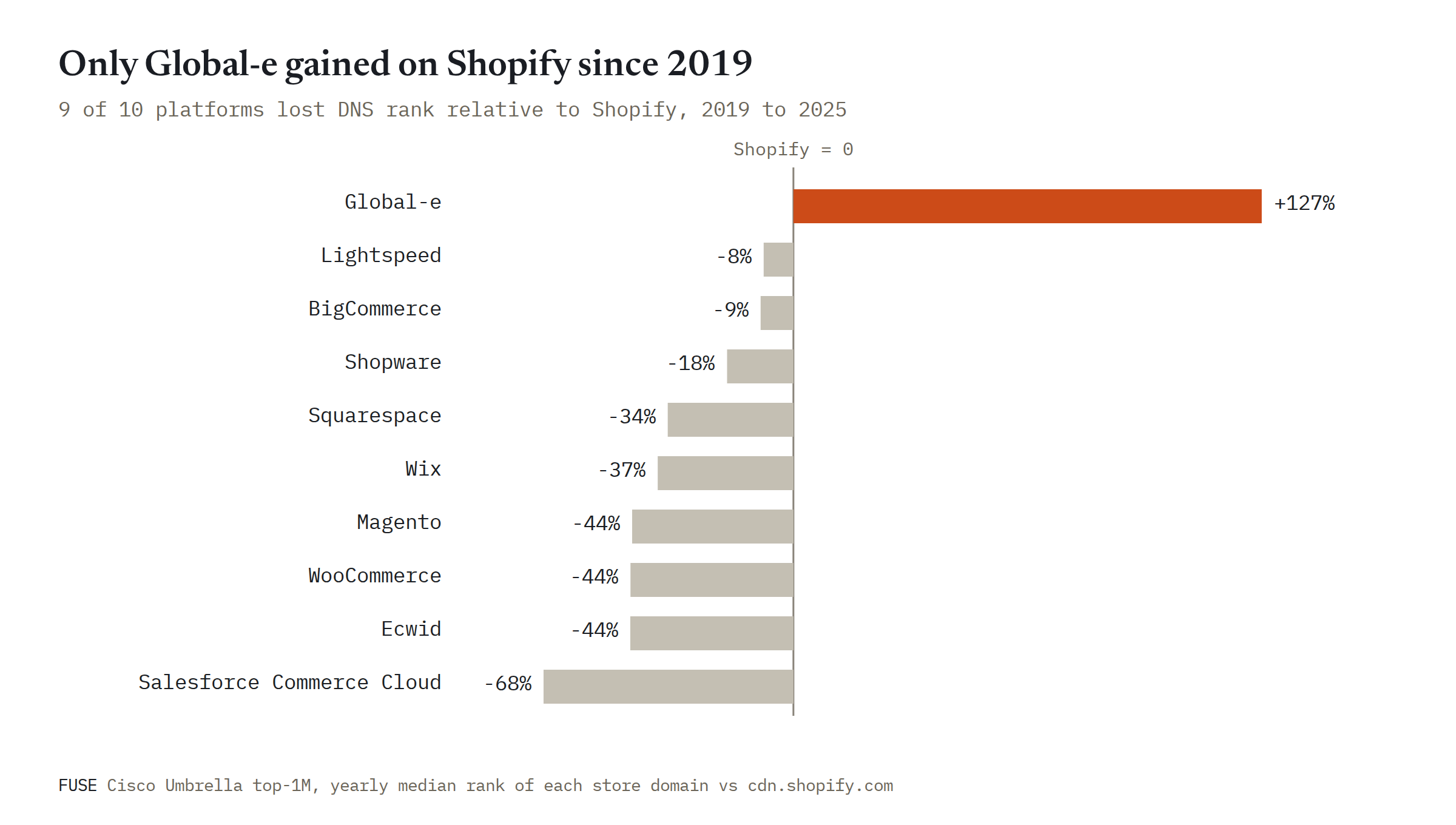
Nine of ten lost ground. Salesforce, one of the biggest names for large brands, lost the most. So far it isn’t AI taking their customers. It’s Shopify.
There’s one exception on the chart. And it doesn’t compete with Shopify at all.
The exception: Global-e
The only company that grew faster than Shopify is Global-e (GLBE), one of its suppliers. When Shopify wins, Global-e wins with it.
Global-e is the border crossing for online stores. When you buy from a foreign brand, it becomes the legal seller: your currency, your payment method, duties and taxes paid upfront, returns handled. The brand sells to 200+ countries without a single foreign entity. On Shopify, it runs as Managed Markets.
Run it through the six questions and it passes four outright, two halfway. Is it ready for agents? Early signs say yes. Management reports rising traffic from AI chats and its first agent-made purchases, still small. And under both OpenAI’s and Google and Shopify’s agent shopping protocols, the merchant stays the legal seller. Abroad, that’s the job Global-e does.
And it’s doing very well. In Q2 2026 revenue grew 39% and volume 44%. Management raised full-year guidance and the EBITDA margin rose 3 points to 21%. It also finished a $200M buyback and approved a new $500M one.
Why not just buy Shopify?
Because Shopify is a great company and the market knows it. For the same growth, Global-e costs about half.
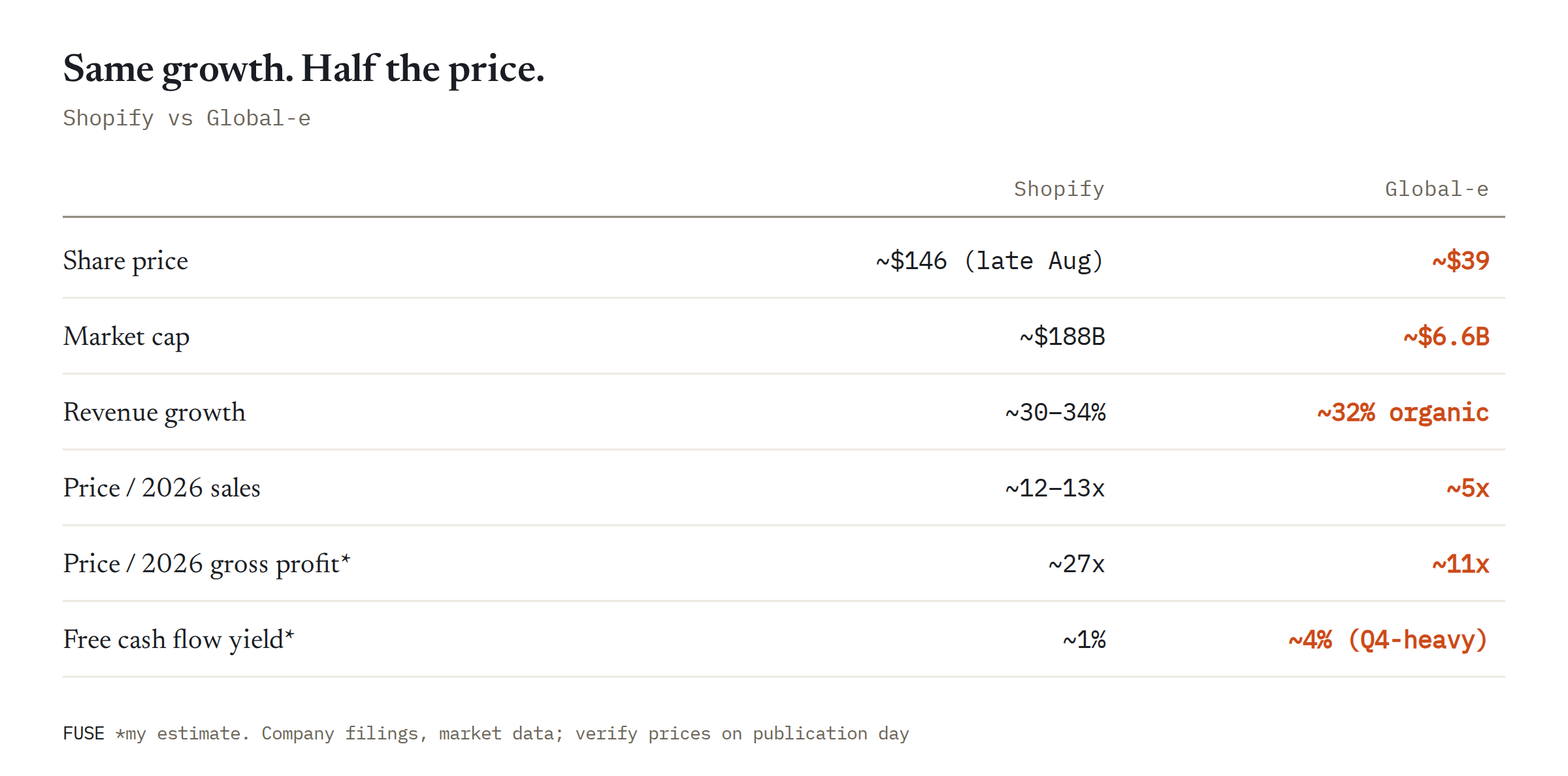
To double, Shopify has to be worth over $375B. Global-e needs about $13B. That bar is a lot lower.
Two companies in one ticker
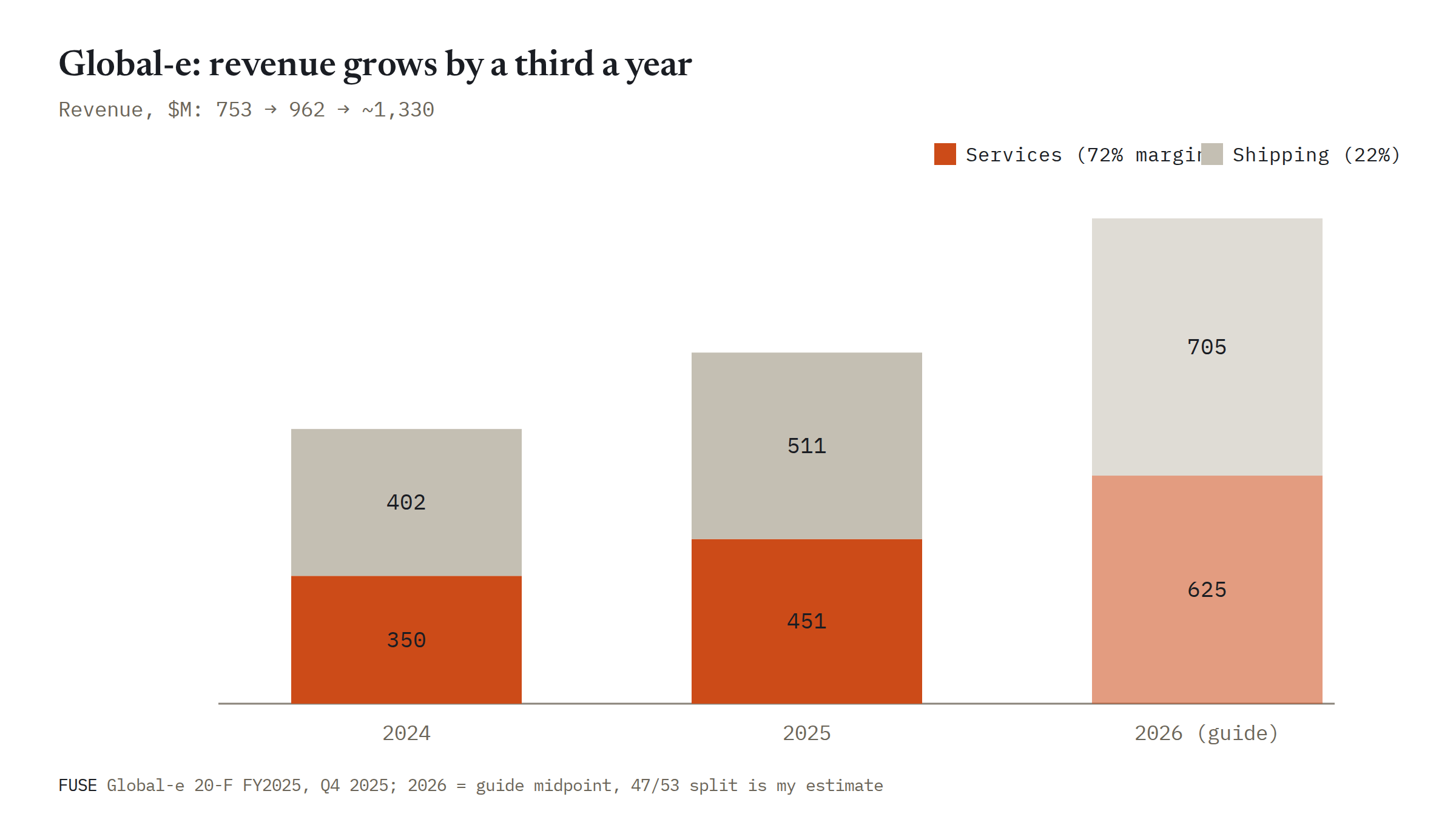
Why so cheap? Because half of Global-e’s revenue is shipping it simply passes on to carriers. So the market prices the whole thing like logistics.
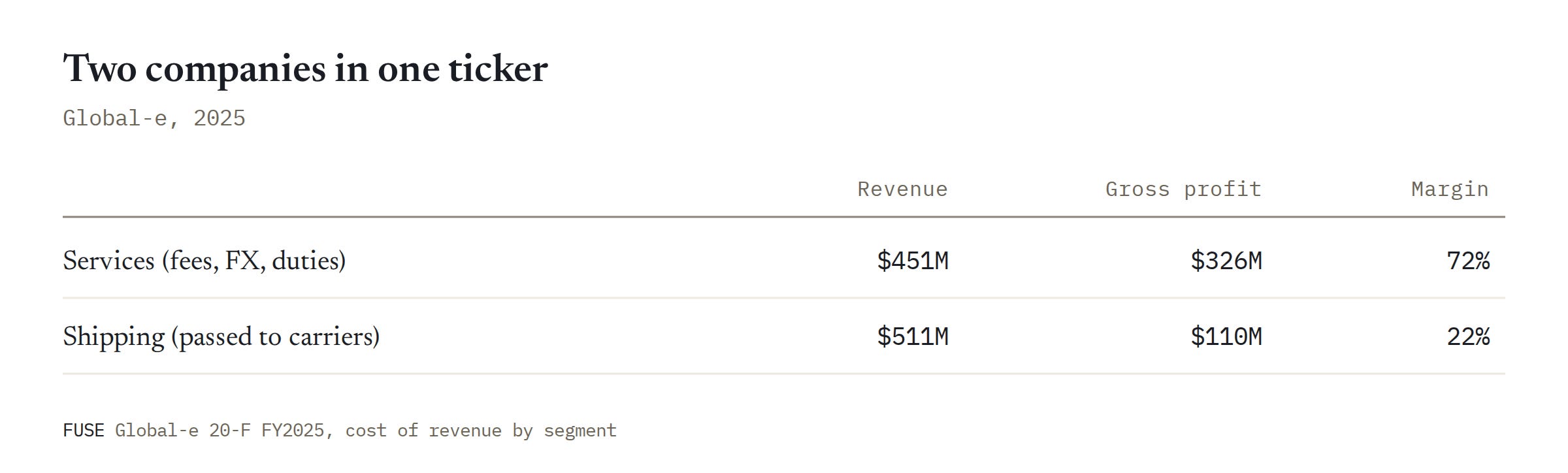
Services are half the revenue and three quarters of the profit. Strip out shipping and today’s price is ~12x services gross profit. For a profitable business growing a third a year, that isn’t expensive. Shipping is the wrapper. Services are the business.
Can Shopify drop them?
In theory, yes. In practice it’s hard. Being the legal seller in 200 countries means tax registrations, licences, duties, fraud and chargebacks in every one of them. That’s years of work and balance-sheet risk a software company doesn’t want. Shopify also received warrants on Global-e shares back in 2021.
The May 2025 agreement runs to May 2028 and renews automatically unless someone gives 180 days’ notice. Global-e kept exclusivity for Managed Markets. For every other Shopify merchant, exclusivity ended, and new versions of the service run on Shopify Payments.
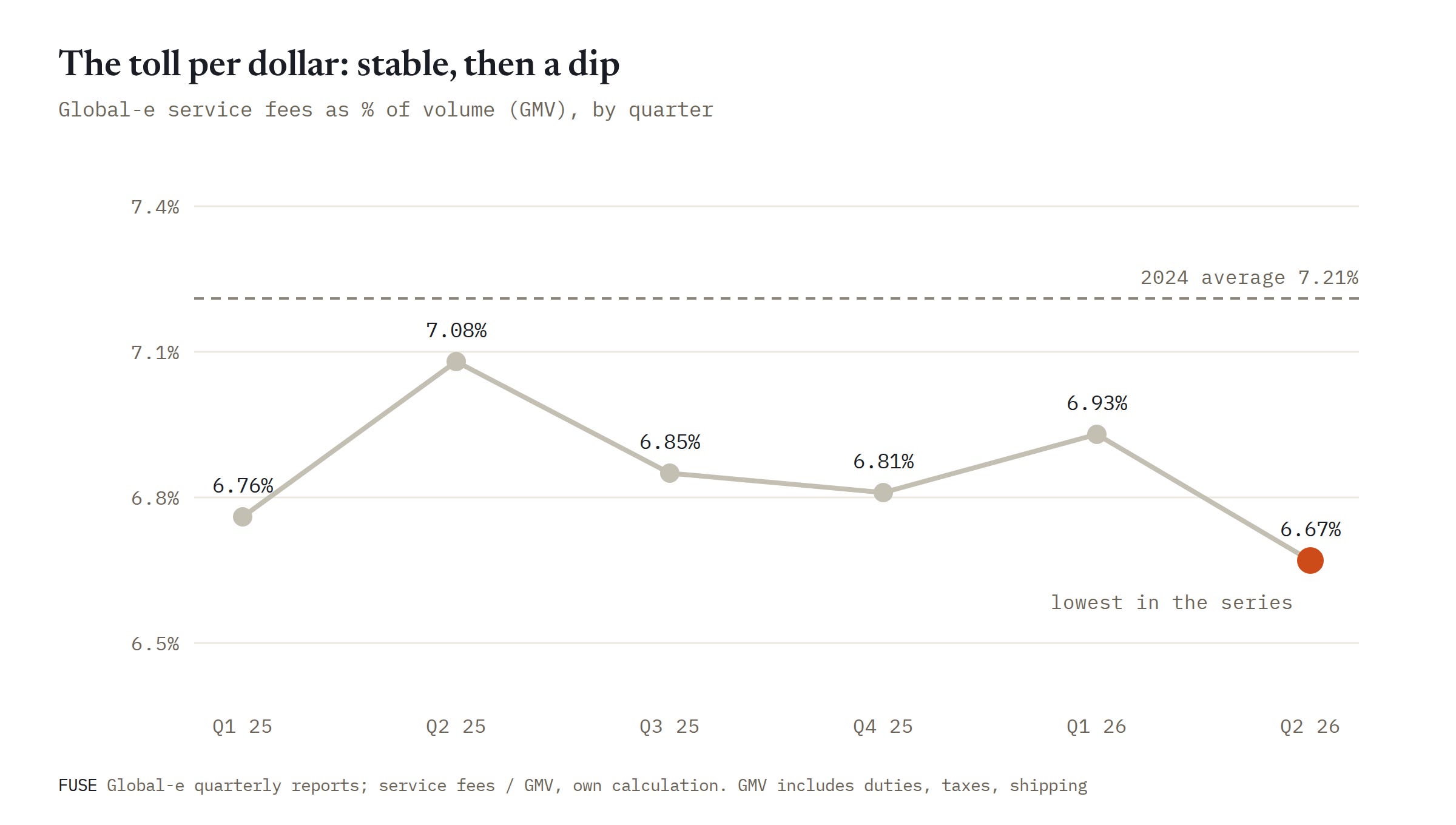
Is the squeeze in the numbers yet? Barely. Global-e keeps about 6.9 cents in service fees per dollar of volume, down from about 7.2 in 2024, as bigger, lower-margin brands joined. Management says the rate has been stable and should stay there in 2026. But Q2 2026 printed 6.67%, the lowest in the series. One suspect is Shopify Payments: once it handles Managed Markets payments, Global-e stops booking them as revenue. One quarter isn’t a trend. Two would be.
Three ways this goes:
Shopify tightens the screws. Most likely. Growth continues, Global-e gets a smaller cut.
Shopify buys it. Takeovers usually come with a 20–50% premium. At today’s price that’s roughly $47–59 a share.
Shopify builds its own. Worst case, and the least likely over the next two years.
Where it could be in two years
I value each half on its own: services on a software multiple of gross profit, shipping on a logistics one. End of 2028, my own weights:
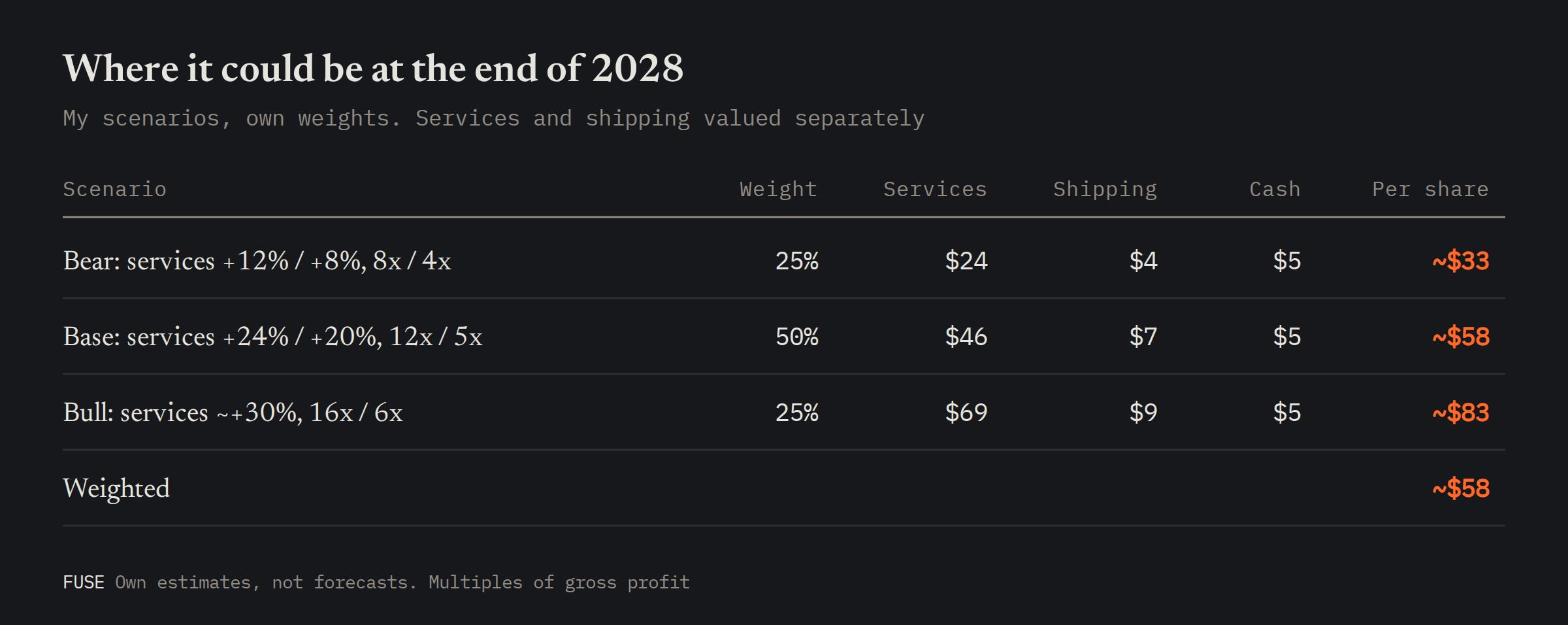
Weighted ~$58, roughly +48% from $39. The base case already assumes services grow slower than volume. A takeover isn’t in the weights; it’s a bonus. Shipping is worth $4–9 a share in every case; the rest is services.
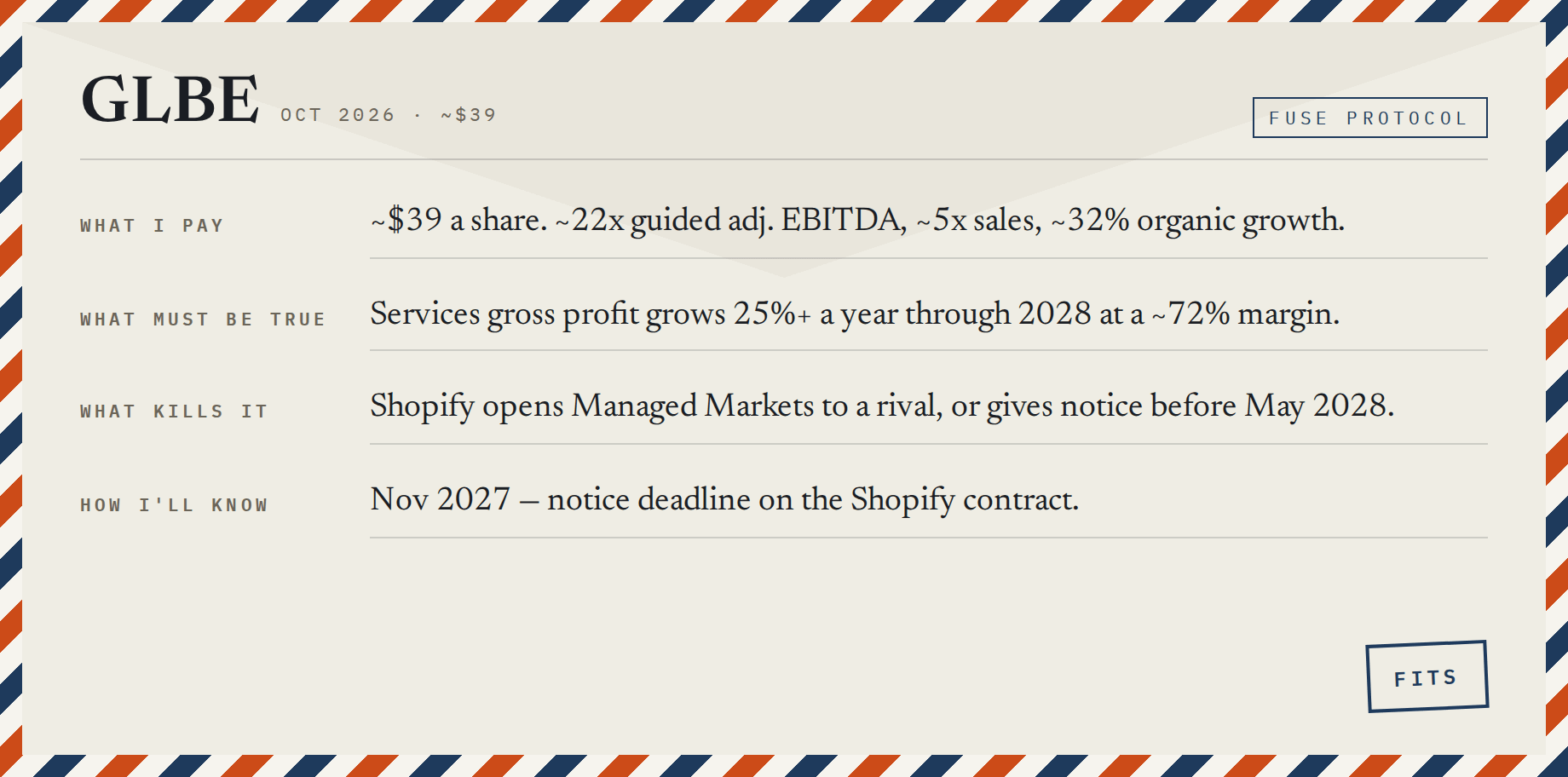
The envelope
Disclosure
I own GLBE, bought at ~$39.
Sources
Global-e 20-F FY2025: 2025 Shopify Agreement, cost of revenue by segment
Global-e Q4 2025 results: 2024 and 2025 revenue split
Global-e Q2 2026 results: growth, segment revenue, FY2026 guidance, new buyback
Global-e and Shopify agreement, May 2025: 1P exclusivity, 3P opened
Shopify 10-K FY2025: GMV $378.4B
Commerce.com FY2025 results: BigCommerce revenue for the DNS calibration
Cisco Umbrella top-1M daily lists, 2017–2026: own archive and calculation, rules written before the data was examined