

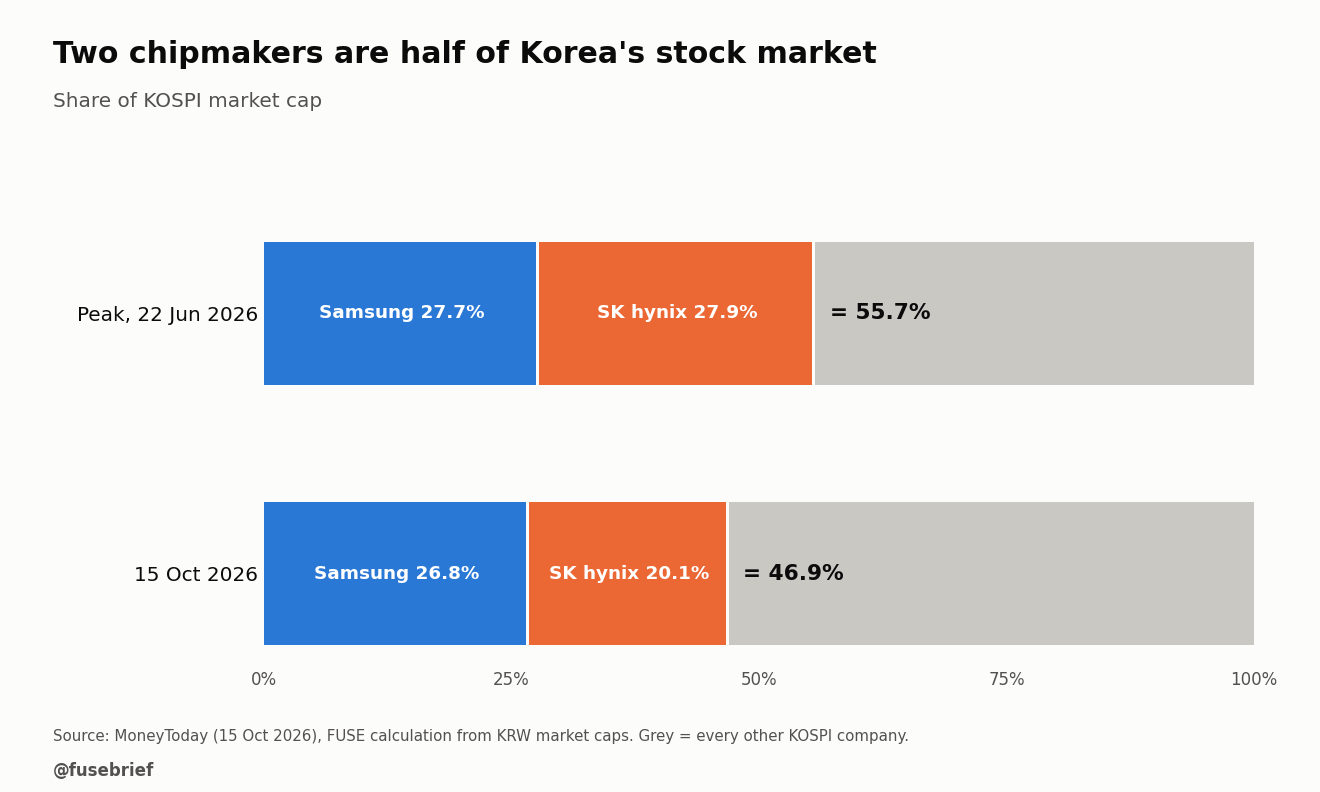
47% of the KOSPI is Samsung and SK hynix. At the June peak it was 56%. Buying “Korea” means buying the memory-chip cycle first and everything else second.
The market. Korea’s exchange dates back to 1956, but foreigners could only buy directly from 1992, and ownership caps fell only in 1998. For outside money, it’s a young market.
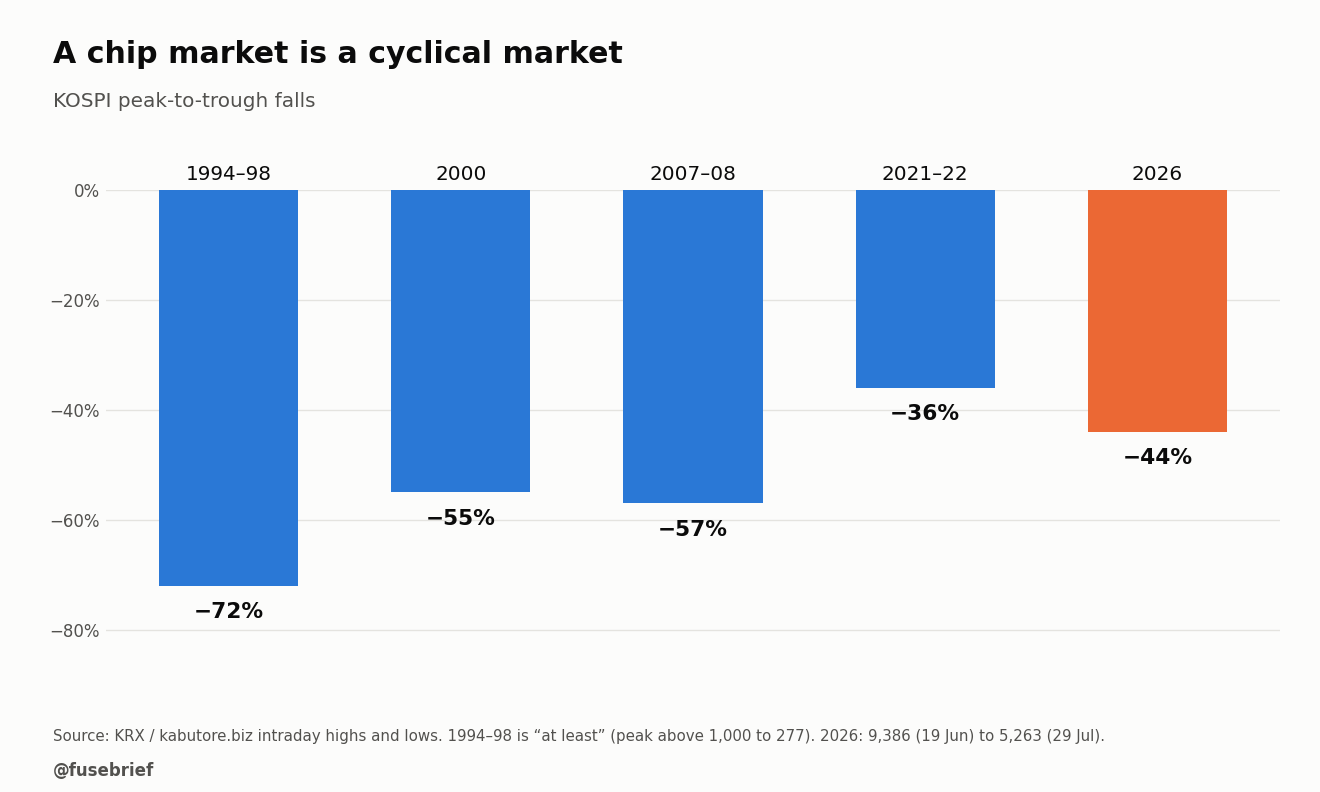
What it costs. KOSPI closed at 5,768 on Oct 19, down 39% from its June high of 9,386. Morgan Stanley puts it at about 1.05x forward book value.
A closed economy. Koreans search on Naver (64% share) more than Google (29%). Walmart and Carrefour both quit the country in 2006. Korea is full of profitable companies outsiders have never heard of.
The evidence. Korea sells sophisticated commodities: memory chips, displays, sensors. Commodities run in cycles, and so does the index.
Outside chips, growth is the problem. Korea’s fertility rate is 0.80. Domestic champions like Naver hit the ceiling of a 51-million-person market. Many small, profitable, family-controlled companies sit on cash and treat minority shareholders as an afterthought. That’s the “Korea discount.”
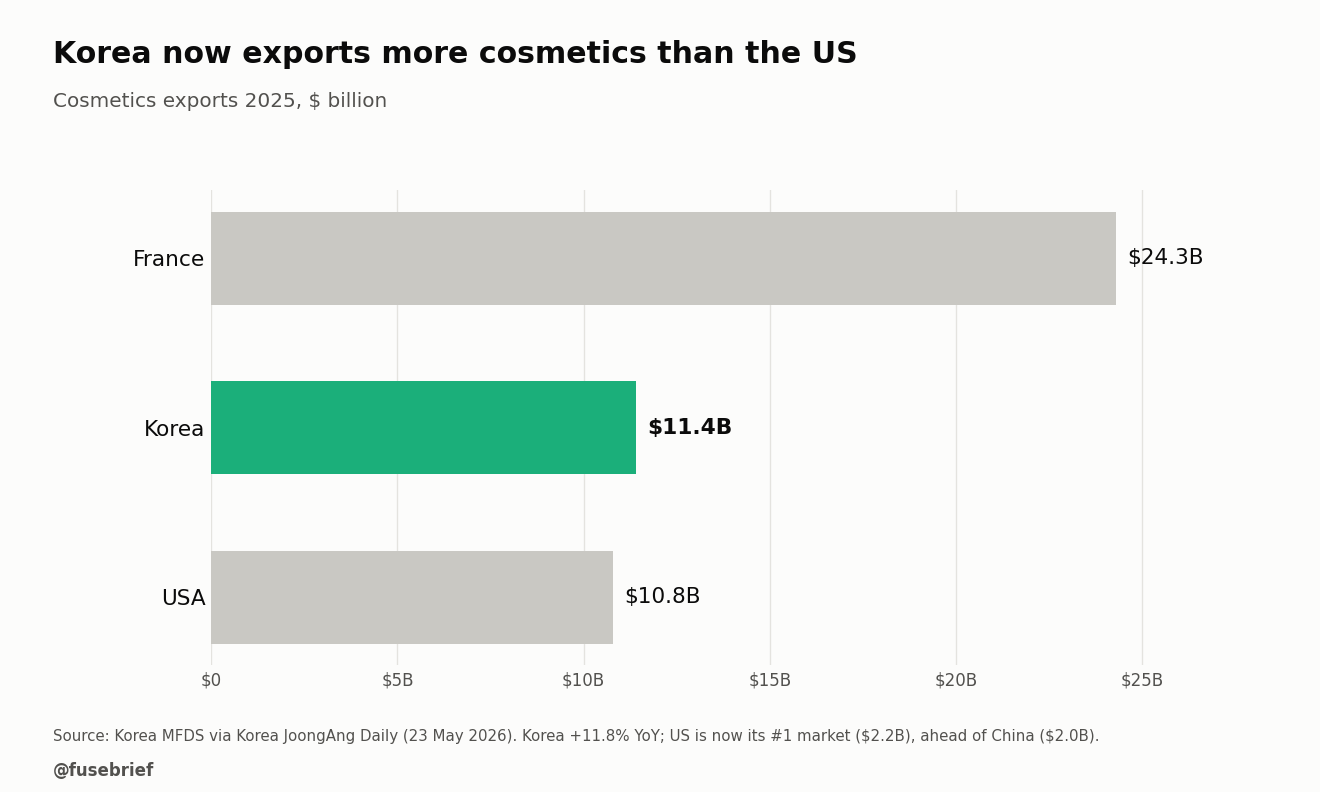
The bright spot. Korean cosmetics now sell more abroad than American ones, and the US has overtaken China as their biggest buyer.
The torque & the timer. Seoul is copying Japan’s 2023 playbook. Since March, companies must cancel repurchased shares within a year. On Nov 2, the exchange publishes its first list of chronically cheap companies, which broker apps will tag “low PBR.” Its own simulation: 120–220 names. Firms can escape by filing a plan to fix their valuation by Oct 22.
The bear case: a late-cycle pattern. This year the flows have run in opposite directions. Foreign investors sold a net ₩199 trillion of Korean stocks (about $149 billion) between January and mid-October. Korean retail investors bought what they sold, and bought it with borrowed money. Margin debt hit a record ₩38 trillion in May. In early October, with the market falling, it went up again, by about 2%. Since late May, Koreans have also been able to buy 2x leveraged ETFs on single stocks like Samsung and SK hynix, and they keep buying them on every dip. In the first two weeks of October alone, retail put ₩7 trillion into those two names.
Smart money selling, retail leveraging up: that’s what a late cycle usually looks like. The end can still be months away. Late cycles often run longer than anyone expects. But the market is clearly weakening: forced margin sales are already back at their highest level since the July crash.
Reforms can close the Korea discount. They can’t stop a chip cycle from turning.
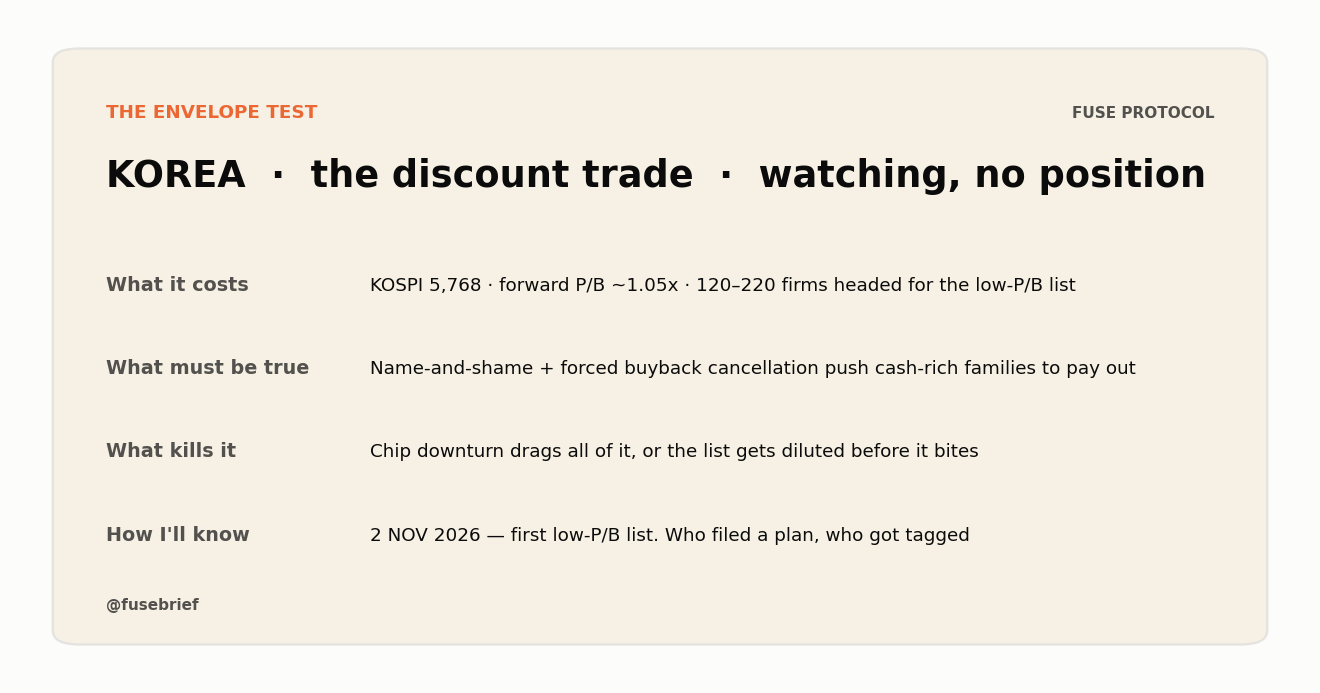
KOREA · the discount trade · watching, no position
What it costs: KOSPI 5,768 · forward P/B ~1.05x · 120–220 firms headed for the low-P/B list
What must be true: Name-and-shame + forced buyback cancellation push cash-rich families to pay out
What kills it: Chip downturn drags all of it, or the list gets diluted before it bites
How I’ll know: 2 NOV 2026
Sources: KRX; KDI; kabutore.biz; MoneyToday (15 Oct 2026); FN News (14, 15 & 19 Oct 2026); Morgan Stanley via Korea Times (18 Oct 2026); InternetTrend via Korea Times (16 Apr 2026); Statistics Korea via Yonhap; Korea MFDS via Korea JoongAng Daily (23 May 2026); Seoul Economic Daily (13, 15 & 17 Oct 2026); KOFIA; FSC/KRX (28 Jul 2026); Legal500/Kim & Chang. Concentration = FUSE calculation.