

Disclosure up front: I don’t own VST. This is a public envelope test of a popular ticker — pre-registered, so you can grade me later.
Vistra is the consensus AI electricity trade: Thiel Macro disclosed a $59M position in Q2, Tepper’s Appaloosa added 10%, 111 hedge funds hold it, and even Pelosi took her cut on the way up via $50 calls. The stock 8x’d from 2022 to its $217 high last September; today it sits ~34% lower at ~$144 while EBITDA keeps growing. The threads quote the data center queue, the nuclear deals, the buybacks.
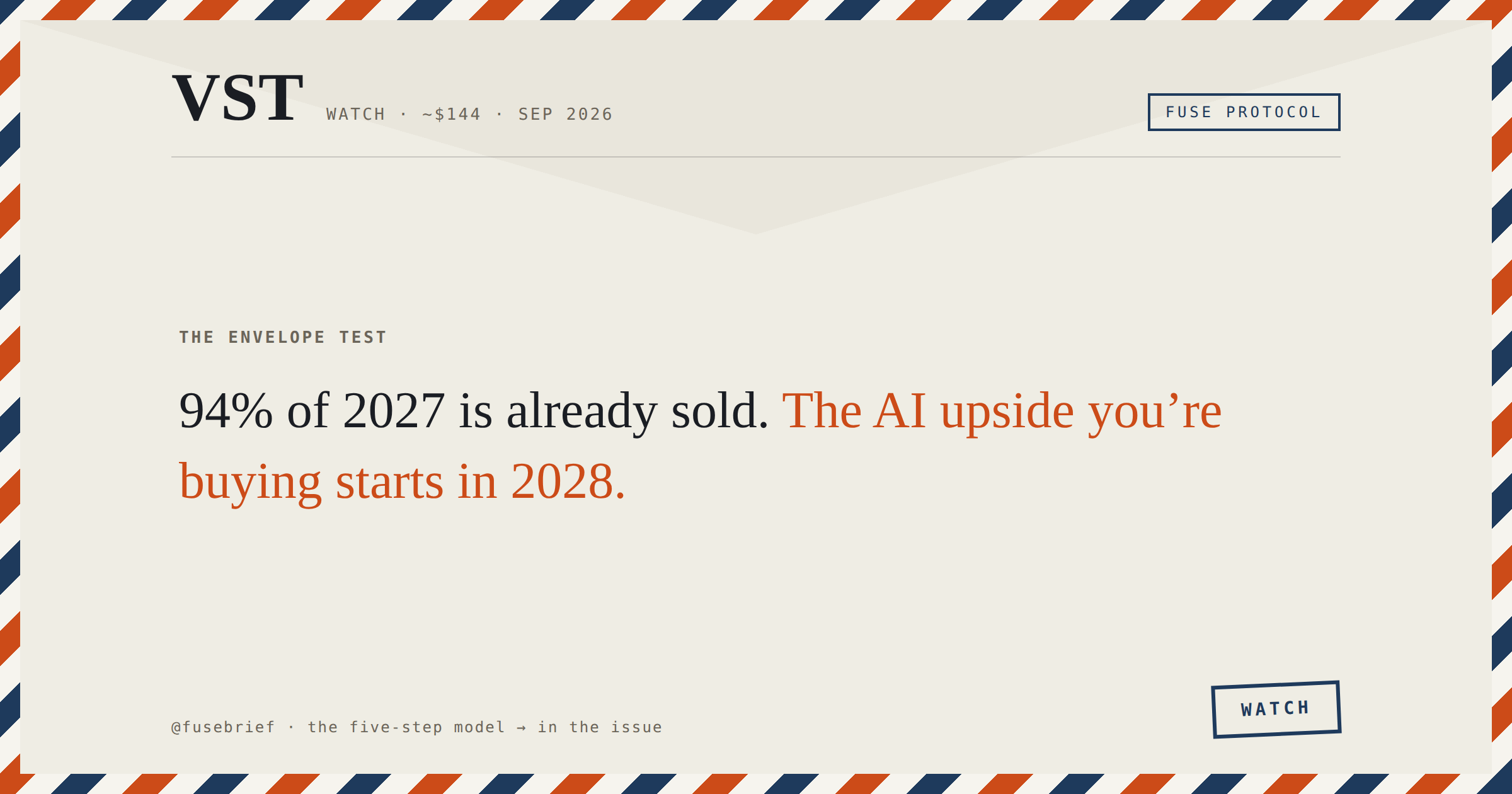
Here’s the number none of them quote: as of August, Vistra has already sold ~94% of its expected 2027 generation.Whatever power prices do next year, Vistra has largely taken its price. The upside everyone thinks they’re buying isn’t in 2027 at all.
To see what that means, walk the model with me. Five steps, every number sourced or labeled as an estimate.
Step 1 — Supply: what Vistra has
43.7 GW of generation: 19.6 GW in ERCOT (Texas) — including the Comanche Peak nuclear plant, an hour from the Dallas–Fort Worth data center corridor — 22.3 GW in the eastern markets (PJM), 1.6 GW in California. Plus 5.5 GW of gas arriving via the $4B Cogentrix acquisition. The nuclear fleet is already partly contracted to hyperscalers: 20-year PPAs with Amazon (1,200 MW) and Meta (2,609 MW).
One structural detail that matters: ERCOT is an island. The Texas grid is barely connected to the rest of the country — power cannot be imported when things get tight. Whoever owns generation inside that closed arena owns the only supply there is.
Step 2 — Demand: what’s coming at Texas
Why does everyone build data centers in Texas? Because ERCOT connects you in years less time than PJM or California (”connect and manage”), power has historically been the cheapest in the country, there’s no state income tax, land is endless, and you’re allowed to build your own gas plant behind the meter. Speed-to-power is everything when your competitor is training while you wait.
The result: ERCOT’s all-time peak load is just over 91 GW (a record set this July). Its large-load interconnection queue hit 474 GW by August 5 — roughly 90% of it data centers. Twenty months ago that queue was 63 GW. Yes, much of it is phantom — hyperscalers file in multiple places and build where it pans out first. Discount it by four-fifths and it’s still ~95 GW of demand knocking on a 91 GW grid.
The paradox that makes this a thesis: they came for cheap power, and their arrival is what kills cheap power. Yesterday’s low price attracted the demand that sets tomorrow’s high one.
Step 3 — The squeeze
Against that demand: only ~23 GW of new generation came online in 2024–25, mostly solar and batteries — which don’t produce on a windless summer night. Grid stress has already shifted from 4–5 p.m. to 8–9 p.m. as solar fades at dusk.
And here’s why supply can’t respond quickly, even with money: gas turbines are sold out. GE Vernova’s backlog hit 116 GW against ~20 GW of annual production capacity — order today, generate after 2030. Siemens and Mitsubishi are booked the same way. Texas has a state fund ready to finance new gas plants; the plants can’t get turbines. That’s also why Vistra buying Cogentrix’s existing fleet at ~$730/kW is rational when a new build costs $2,000+/kW and delivers in 2030.
Step 4 — Price: what 2028 power might sell for
Exact PPA prices are private — anyone quoting them is guessing. Two public proxies bracket it: ERCOT forwards for 2025–2028 already trade above $50/MWh, with summer on-peak months at $110–165/MWh in some hubs. The EIA’s high-demand scenario puts ERCOT 2027 at ~$85/MWh versus a $47 baseline — a 79% premium. And the Meta/Amazon nuclear PPAs tell you hyperscalers pay up beyond that for firm, clean power.
Rough torque, clearly labeled napkin math: Vistra’s 2028 book is only ~72% hedged. Estimate the fleet’s output from capacity (43.7 GW at segment-typical capacity factors ≈ ~170 TWh/yr; Vistra doesn’t publish a clean TWh number) and the open ~28% is ~48 TWh — so every +$10/MWh on the unhedged book is very roughly ~$0.5B of EBITDA. The same lever swings the other way if hyperscaler capex gets cut — in exactly the year that isn’t protected.
Step 5 — The timer
Vistra discloses its hedge percentages every quarter, and initiates next-year guidance on the Q3 call — due in early November (last two years: Nov 6 and Nov 7; date not yet announced). Between now and then, the only question that matters is at what level they lock the remaining 2028 volumes. Rising forwards + Vistra hedging into them = the 2028 step-up becomes arithmetic instead of hope. Flat hedges = the AI premium in this stock is paying for optionality management itself isn’t capturing.
I don’t have to predict power prices. I have to read one table in early November — and I’m telling you now, in advance, what it has to say.
Scenarios, with probabilities I’ll grade later
My subjective calibration for where VST trades at some point during 2027 (today: ~$144):
ScenarioRangeProbabilityBear — AI capex cuts, forwards roll over$110–140~15%Base — nothing confirms, no re-rate$140–170~30%Mid — November confirms richer 2028, partial re-rate$170–220~35%High — EIA high-demand + market pays a utility multiple$220–260+~20%
Probability-weighted midpoint ~$180. I’ll revise these publicly after the Q3 call — that’s the point of writing them down now.
Two numbers for the bears, because honesty
$18.7B of net debt is real and grows with Cogentrix. And Q2’s ugly GAAP print absorbed a $472M unrealized loss on unsettled hedges — an accounting mark that reverses — while adjusted EBITDA rose 31% and guidance ($6.8–7.6B this year; $7.4–7.8B opportunity for 2027 before Cogentrix and Meta) didn’t move. Much of the scary tape is optics on top of leverage, not deterioration. The real risk isn’t this year’s income statement; it’s 2028 arriving into an AI capex winter with the hedges gone.
The envelope
VST @ ~$144
WHY THE MARKET OWNS IT: AI power demand — a 474 GW queue on a 91 GW island grid
WHY I DON'T (YET): 2027 is 94% sold. The option starts in 2028 — where hedges end and forecast risk begins
WHAT I PAY: ~24x trailing EPS, ~9x EV/EBITDA on the 2027 outlook, $18.7B net debt
WHAT WOULD CHANGE MY MIND: the early-Nov Q3 call — the prices at which they hedge the rest of 2028
Verdict: watch, with a date. Pre-registered today so you can grade me after the November call.
To be clear: this is not a bearish call. Vistra is a good business and it sits on my watchlist. Two things would get me genuinely interested: the November table saying the right thing — or a price closer to $110–120, where you’d be paying for the bear scenario and getting the 2028 option nearly for free. That’s a level I’d have to think hard about.
And this theme doesn’t end here. I’m working through the rest of the AI power supply chain — the arena is bigger than one ticker, and somewhere in it there may be a better-priced way to own the same bottleneck. If I find it, it will show up in a future issue, pre-registered like everything else. If I don’t, I’ll tell you that too.
This is not investment advice. It’s a pre-registered record of one investor’s reasoning, published so it can be checked later.
Sources: Vistra Q2 2026 results — hedge percentages, guidance, buybacks · Vistra–Meta 20-yr nuclear PPAs, 2,609 MW· Vistra–Amazon 20-yr PPA, 1,200 MW (SEC filing) · Utility Dive: fleet 43.7 GW, ERCOT 19.6 GW, load +6.5% · Utility Dive: 474 GW queue, Texas pause · EIA: ERCOT high-demand price scenario +79% · GE Vernova Q2 2026: 116 GW backlog · POWER: Cogentrix $4B / 5.5 GW · Simply Wall St: $472M unsettled hedge loss, $18.7B net debt · Macrotrends: VST price history · EIA: ERCOT record peak >91 GW, July 22, 2026 · Yahoo: Thiel Macro $59M stake