

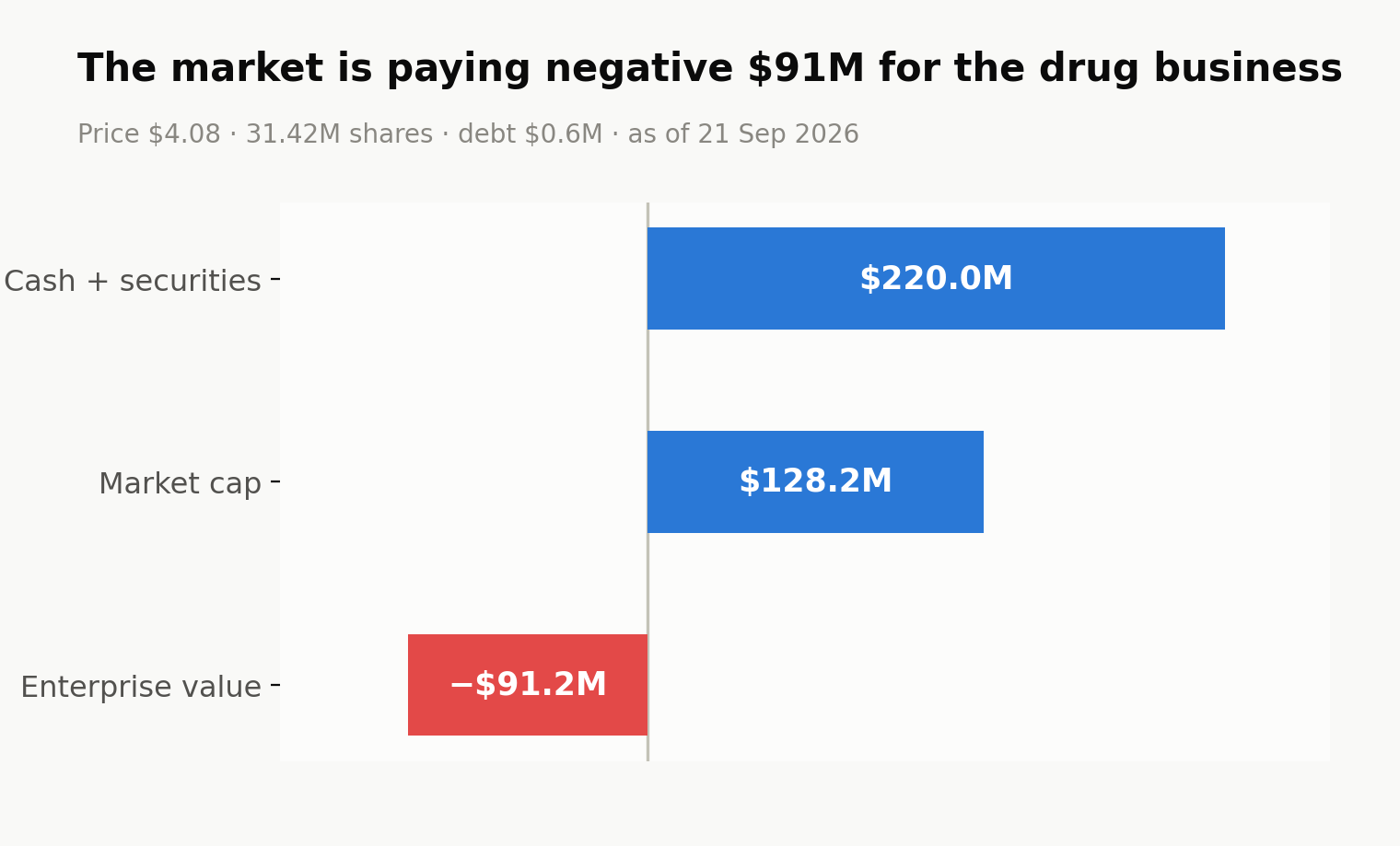
LENZ Therapeutics trades at $4.08 — a $128.2 million market cap. The company holds $220.0 million in cash and securities against $0.6 million of debt. Net those out and enterprise value comes to −$91.2 million. The market isn’t calling this business cheap. It’s saying the operating business is worth less than nothing — that you’d be better off if LENZ shut it down tomorrow and mailed back the cash.
I think that number is wrong, because the market is overlooking two things.
What the company does. LENZ makes VIZZ, a once-daily eye drop that treats presbyopia — the blurry near-vision almost everyone develops with age, the reason reading glasses exist. FDA-approved, selling since October 2025.
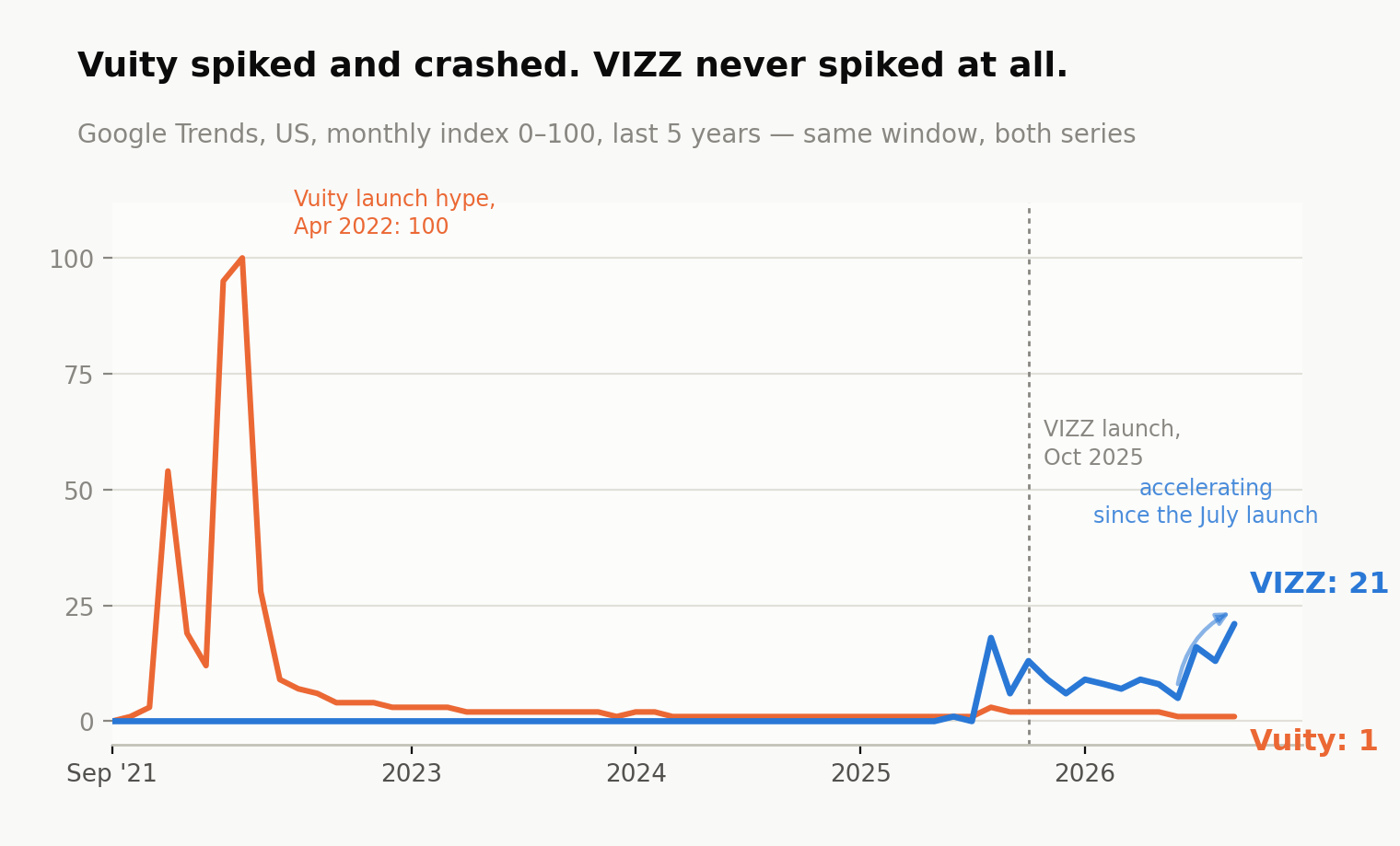
Why the market prices it this way. VIZZ isn’t the first drug to promise this. AbbVie’s Vuity got there first, in 2022, with a huge launch and a wave of hype — then it flopped. Patients tried it and stopped: short duration, headaches, dim vision at night. AbbVie quietly cut its marketing spend within the year, and search interest for Vuity has sat near zero ever since. Then LENZ had its own stumble — a Q4 2025 sales miss management never explained well — and the stock is down 91.9% from its high. Put the two together and the market’s read is simple: this category disappoints, and LENZ is just the next chapter of the same story.
The first thing it’s missing: retention. Vuity’s problem was never that people wouldn’t try it — it’s that they wouldn’t stay on it. That’s a retention failure. VIZZ’s data says the opposite is happening: 75% of its 13,000+ prescribers write it more than once, and over 60% of ePharmacy patients buy a second pack. People are staying on the drug. That’s the one thing Vuity never had, and it’s not in the stock price because it’s not in the revenue line yet — it’s in a metric nobody’s pulling up next to the ticker.
The second: two signals moving together that the market hasn’t connected. In the last six weeks, LENZ launched a national TV campaign and a telehealth option together, on July 6. Management says July prescriptions rose over 45% month-over-month. Separately — and this isn’t company talk, it’s just people searching Google — interest in “VIZZ” has been climbing on the same timeline, and just hit its highest point since launch. Put that next to Vuity on the same five-year scale and the shape is the opposite of hype: Vuity spiked to 100 in its launch month and was back near zero within a year. VIZZ never spiked at all — it’s been a slow, uneven climb since October 2025, still rising now. A demand-side signal and a company-reported signal, moving the same way at the same time, and neither one looks like a fad. That’s the thing the market is missing.
The squeeze setup. This is also, mechanically, a squeeze — and a squeeze without a catalyst is just a tight technical picture that can stay tight forever. Short interest is 57.46% of the free float (18.4 million shares), up from 54.48% a week earlier. Days-to-cover: 12.44. Cost to borrow has climbed to 1.19%, and — the number that matters most — availability, the pool of shares a new short could actually borrow, has collapsed from roughly 39% to 14.38% in three months. ORTEX’s own short score puts it at 82.64 out of 100. None of that forces a move by itself. What it means is that if a catalyst does land, the shorts trying to cover into it are working with a smaller, more expensive, faster-shrinking pool of borrowable stock than they had this summer. Q3 is the candidate catalyst. The setup has been getting tighter every week I’ve watched it; it just needed a reason.
What keeps this honest. None of this is in revenue yet — product sales were $1.7 million in Q2 against a $31.9 million net loss. But that loss isn’t a fixed cost of staying alive: roughly 80% of it is sales and marketing, a choice, not a bill. This was never going to be a mass-market drug — it doesn’t need to be. At ~$63 a pack and roughly five packs a year for a loyal patient, it takes only about 140,000-180,000 patients to cover a scaled-back “maintenance” budget once the campaign spend is throttled, and 250,000-350,000 to be comfortably profitable — a few tenths of a percent of the 128 million Americans with this problem. The obvious play, if you own this, is to spend hard to acquire while the campaign is working, then cut back and harvest a loyal, recurring base.
That’s also where the real risk sits — not “the company runs out of cash,” but “the base doesn’t get big enough before the spending either keeps burning without proof, or gets cut too early.” And the squeeze setup cuts both ways, same as the short interest itself: it can amplify a re-rate, or it can mean money smarter than me is looking at the same timing risk and isn’t wrong to be short.
So. I’m taking a small lottery-ticket position — sized for what this is, not for what I hope it is.
Here’s the actual bet: the market hasn’t re-run this math since the Q4 miss. It’s still pricing LENZ off the old story — one flopped category, one bad quarter, nothing since worth updating on. But two things have moved that the price hasn’t: the prescriber persistence data, and now two straight months of search-and-script growth moving together. If that holds through Q3, the market doesn’t get to keep ignoring it — the print forces a re-rate one way or the other. That’s the trade. Not “VIZZ will win.” Just “the market is currently refusing to look at evidence it doesn’t have an excuse to ignore much longer.”
This stays a genuinely risky trade. The cash floor, and the option to throttle spend, limit how badly it goes. Neither decides whether it goes badly. I’m pre-registering the thesis now, before the Q3 print exists — so whichever way it breaks, it gets graded honestly in November, not rewritten to fit.
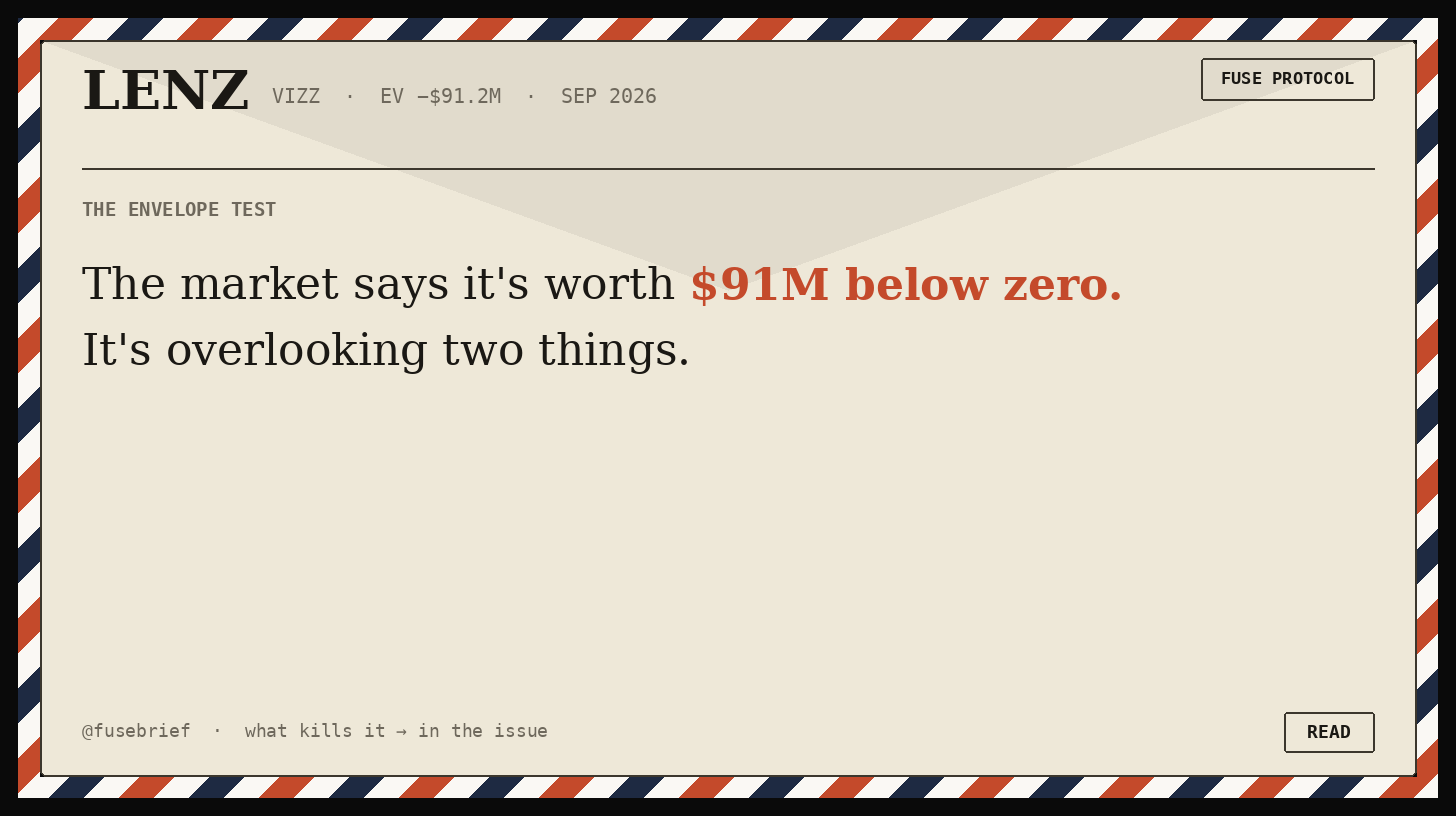
Envelope card and charts below.
Sources: LENZ Therapeutics Q2 2026 financial results (GlobeNewswire, LENZ IR, 11 Aug 2026); LENZ Q2 2026 earnings call (19 Aug 2026); ORTEX short-interest data (21 Sep 2026); Google Trends, US, monthly, 5-year (21 Sep 2026).
What I pay: $4.08 · EV −$91.2M · 57% of float short What must be true: Aug/Sep hold double-digit MoM growth, not a reversion to single digits What kills it: Base stalls before it's big enough to harvest — spend cut too early or burned too long without proof How I'll know: Q3 print, ~17 Nov 2026 (est.)