

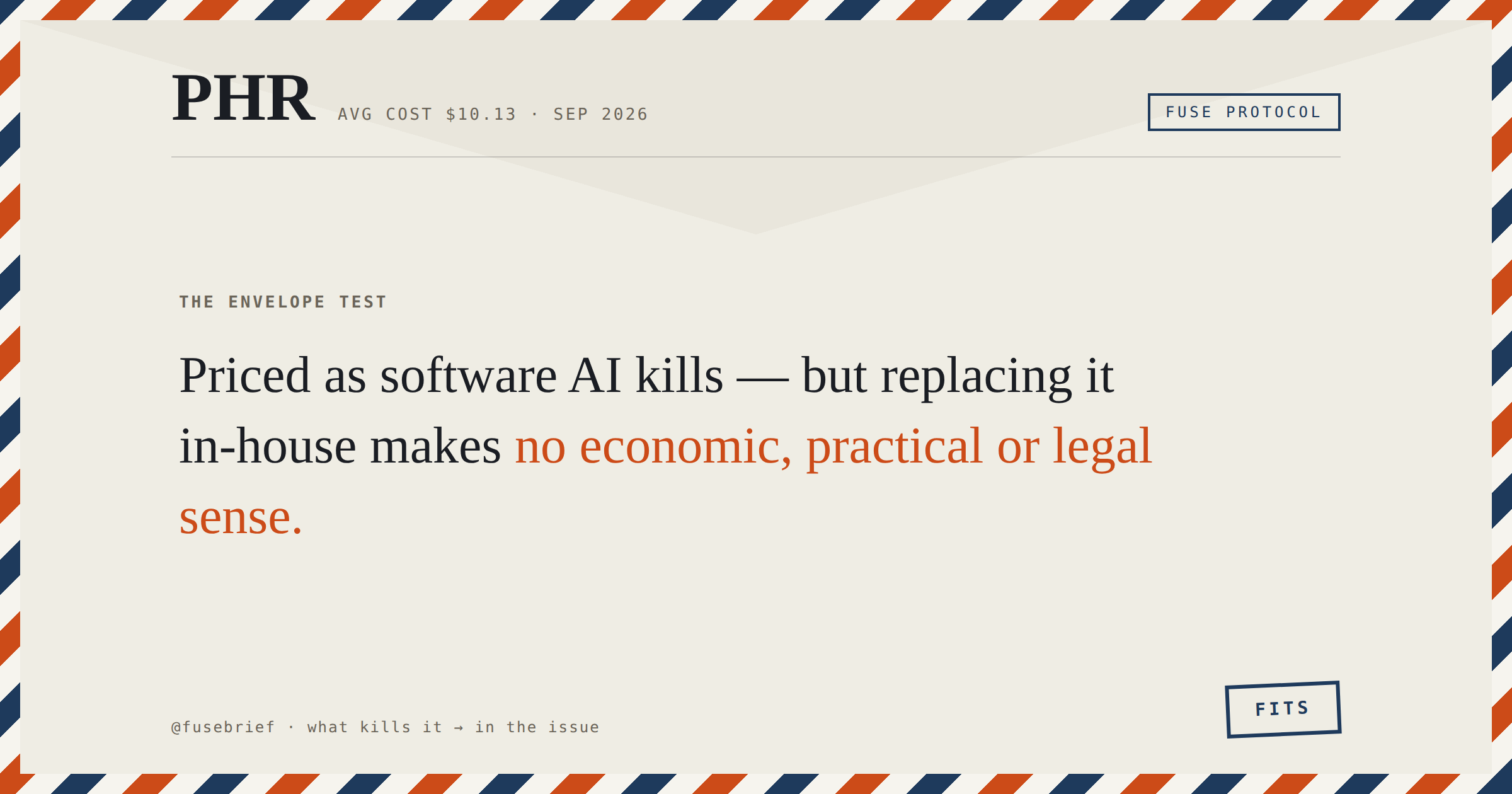
Disclosure up front: I own PHR and I added more near $11 after the earnings drop; my average cost is $10.13. This post explains why — and exactly what would make me wrong.
What happened
Phreesia reported Q2 FY2027 on September 2. Revenue $129.5M, up 10% YoY, slightly ahead of estimates. EPS came in at $0.03 against a $0.09 consensus. The stock sold off to ~$11.
That’s the whole market reaction: one line — the EPS miss — set the price. Fair enough. But I don’t own PHR for this quarter’s EPS. So instead of reacting, I re-ran the card I wrote before I ever bought.
Why I own it at all
PHR is one leg of a three-name basket (PHR, QNST, CCSI) built on a single thesis: the market is pricing “AI will replace this” into companies whose actual position is much harder to replace than the headline suggests. FUSE type 3: beaten down hard from highs, positive free cash flow, and a business the customer would feel pain switching away from.
Phreesia’s moat isn’t the software demo — it’s where it sits. Patient intake is wired into the front desk’s workflow at the exact moment of the visit. Ripping it out means retraining staff, re-integrating billing, and risking the one interaction that collects the money. And “just build it in-house” is more expensive than it sounds: intake touches HIPAA-regulated patient data and PCI-scoped payments, so replacing Phreesia means becoming a healthcare compliance vendor overnight — the liability moves onto your own books. No rule forbids it; the cost of doing it right is the barrier. The arithmetic is brutal: the average client pays Phreesia ~$27k a year — one developer costs six times that, before a single line of code.
And the clinic only pays for part of this machine. Roughly 60% of Phreesia’s revenue doesn’t come from the clinic’s subscription at all — it comes from monetizing every patient who walks in: their payment at check-in, and the pharma ad they see during intake. That subsidy is why the product stays cheap for the clinic, and why building your own means competing with something that pays for itself elsewhere. And even at full cost, the in-house version would be worse: Phreesia spreads its development across 4,744 clients, processes payments at a scale one practice can’t negotiate, and sells advertisers reach across millions of patients — a single waiting room has none of that.
The honest caveat: this math protects the long tail of practices. For large health systems, the real threat isn’t DIY — it’s their EHR vendor bundling intake for free. Watch the client mix.
The quarter, against the card
What must be true: clients keep paying more over time, and the network business keeps growing.
Total revenue per client: $27,289, up 4% YoY
Average healthcare services clients: 4,744, up 6% YoY
Network solutions: $38.3M, up 9% YoY
Adjusted EBITDA: $32.9M vs $22.1M a year ago — up ~49%
Free cash flow: $13.8M vs $9.6M, over $23M of debt paid down in the quarter
Guidance maintained: $510–520M revenue, $125–135M adjusted EBITDA
Here’s the number nobody’s quoting: EBITDA grew ~49% year over year, and the stock fell on an EPS line burdened by a ~220-position restructuring charge. The market graded the accounting; the cash machine got faster.
The honest negative: subscription revenue was $52.7M, down from $53.7M a year ago. Management says this is deliberate: providers are under economic strain, so Phreesia is easing subscription pricing and monetizing downstream instead — the CFO said outright that revenue may shift out of subscription into Network Solutions in H2, with the total outlook unchanged. That’s a coherent strategy, and it’s exactly why my kill criterion was never “subscription must grow.” It’s “subscription falls and revenue per client stops growing.” The first half just happened; revenue per client grew 4%. Yellow, not red — and if the strategy stops working, the explanation won’t save the position.
The tripwires (written before this print, unchanged)
Subscription decline persisting past Q4 without growth in total revenue per client → position under review.Status: subscription declined, but revenue per client grew 4%. Yellow, not red. Two more quarters of data decide this.
Network solutions YoY negative in H2 → position under review. Status: +9%. Green.
If tripwire 1 trips, I don’t get to re-argue the thesis. That’s the point of writing it down now, in public, while the outcome is unknown.
The full card
PHR @ $10.13 avg
WHY: priced as software AI kills — but replacing it in-house makes no economic, practical or legal sense.
WHAT I PAY: ~1.2x forward revenue, $125–135M EBITDA guided this year
WHAT KILLS IT: subscriptions still falling after Q4, or ad network turns negative in H2
HOW I'LL KNOW: Q3 + Q4 prints; public resolution either way
I’ll grade this card in public when the data lands — wins and losses at the same font size.
This is not investment advice. It’s a pre-registered record of one investor’s reasoning, published so it can be checked later.